What Is Merged Mining and Why It Changes Your Daily Yield
Merged mining means one machine secures two chains at once: the hash power you already point at Bitcoin or Litecoin also produces valid work for a second, auxiliary chain, and you are paid for both. It adds no hashrate and very little power draw, but it does add a second revenue stream with its own price and its own volatility. On a 600 TH/s rig earning $22.80 of gross BTC per day, that extra stream is frequently the difference between a $4.60 daily margin and no margin at all.

Key takeaways
- Merged mining lets a machine secure a parent chain and an auxiliary chain together, and multi-coin pools support switching between chains without moving hardware — LTC/DOGE is the classic pair.
- It does not raise hashrate or your share of network output: per-terahash income still runs at about 0.0000004486 BTC per day at a difficulty of 132.76 T.
- A 600 TH/s rig at 20 J/TH draws 12 kW, which is 288 kWh a day and $17.28 of power at $0.06/kWh against $22.80 gross — so a small auxiliary stream can matter more than the headline BTC number suggests.
- As with any payout, the pool's listed fee still applies to each component: 4% where the block-reward part is settled per share under PPS+, 2% on PPLNS-distributed components.
Definitions first
The parent chain is the one your machine is nominally mining — Bitcoin, Litecoin or Kaspa. The auxiliary chain is a second chain that accepts the same proof of work. Merge-mined chains were designed so that a valid parent-chain block can also commit to a block on the auxiliary chain, which lets one unit of work count twice without any extra computation and without weakening either network's security.[1]
The practical version is simpler than the cryptography. Litecoin mining commonly carries Dogecoin along with it, so a single Scrypt machine earns both coins per share of work. Pools that operate several chains also let you move that machine between BTC, BCH, KAS, ZEC, HNS, CKB and ETC — over twenty assets in total — without changing operator or rewiring a rack.
Two things merged mining is not. It is not free money: the auxiliary chain has its own difficulty, its own block reward and its own price, and those decide what the second stream is worth on any given day. And it is not extra load on your hardware, since the machine performs the same number of hashes it was already performing.
What it adds to a daily yield
Start from the BTC-only baseline. At a difficulty of 132.76 T and a network hashrate near 1,003 EH/s, the network distributes 450 BTC of subsidy a day, and dividing that by total hashrate gives roughly 0.0000004486 BTC per terahash per day. Multiply by your hashrate, price it at $84,692, then subtract the pool fee and electricity — that is the number a merged-mining configuration is meant to improve.
| Hashrate | Gross per day | After the listed 4% block-reward fee | Electricity per day | BTC-only margin |
|---|---|---|---|---|
| 60 TH/s | $2.28 | $2.19 | $1.73 | $0.46 |
| 600 TH/s | $22.80 | $21.88 | $17.28 | $4.60 |
| 6 PH/s | $227.96 | $218.84 | $172.80 | $46.04 |
The pattern is consistent: power consumes roughly three quarters of gross income at a 20 J/TH efficiency and $0.06/kWh, leaving a thin slice for everything else. That thin slice is where an auxiliary-chain payout lands, and it is why operators on marginal hardware care about merged mining more than operators running the newest, most efficient machines.
The trade-off nobody prices
The obvious cost of merged mining is the pool fee applied to the auxiliary payout. Under PPS+ the listed rate is 4% on the block-reward component that is settled per share, and 2% on components distributed through PPLNS logic; under PPLNS the block reward and transaction fees are combined and carry a listed 2% rate. Nothing about merged mining creates a fee-free stream — it is another payout with a listed fee attached.[2]
The less obvious cost is exposure. You are now paid partly in an asset you did not choose, whose price may fall between distribution and conversion. That is manageable rather than dangerous — auto conversion between supported assets removes the manual step, and holding the auxiliary coin is itself a decision you can reverse — but it does mean the extra stream arrives with price risk that the BTC-only baseline does not have.
There is also an operational cost that rarely appears in any calculation. A machine configured for two chains produces two payout records, two sets of balances and two conversion decisions, and the accounting gets messier as the fleet grows. An account that shows per-worker hashrate alongside both payout streams is worth more on a hundred-machine farm than it is on a two-machine setup.
Example with two setups
Setup A is a 600 TH/s rig running BTC only. Its output is 0.0002692 BTC a day, which is $22.80 gross at today's price. The rig draws 12 kW at 20 J/TH, so it consumes 288 kWh a day and pays about $17.28 for power at $0.06/kWh. After the listed 4% rate on the block-reward component, $21.88 remains, and the rig keeps roughly $4.60 a day — 20% of gross, before hosting, cooling or maintenance. In BTC terms, the same rig needs about 37 days to produce 0.01 BTC.
Setup B is the same rig with an auxiliary chain enabled. The BTC figures do not change, because merged mining does not alter your share of network hashrate. What changes is that a second stream appears with no additional compute, and its contribution depends on the auxiliary chain's own difficulty and reward rather than on yours. The correct way to model it is as an addition to $4.60, not as a multiplier on $22.80.
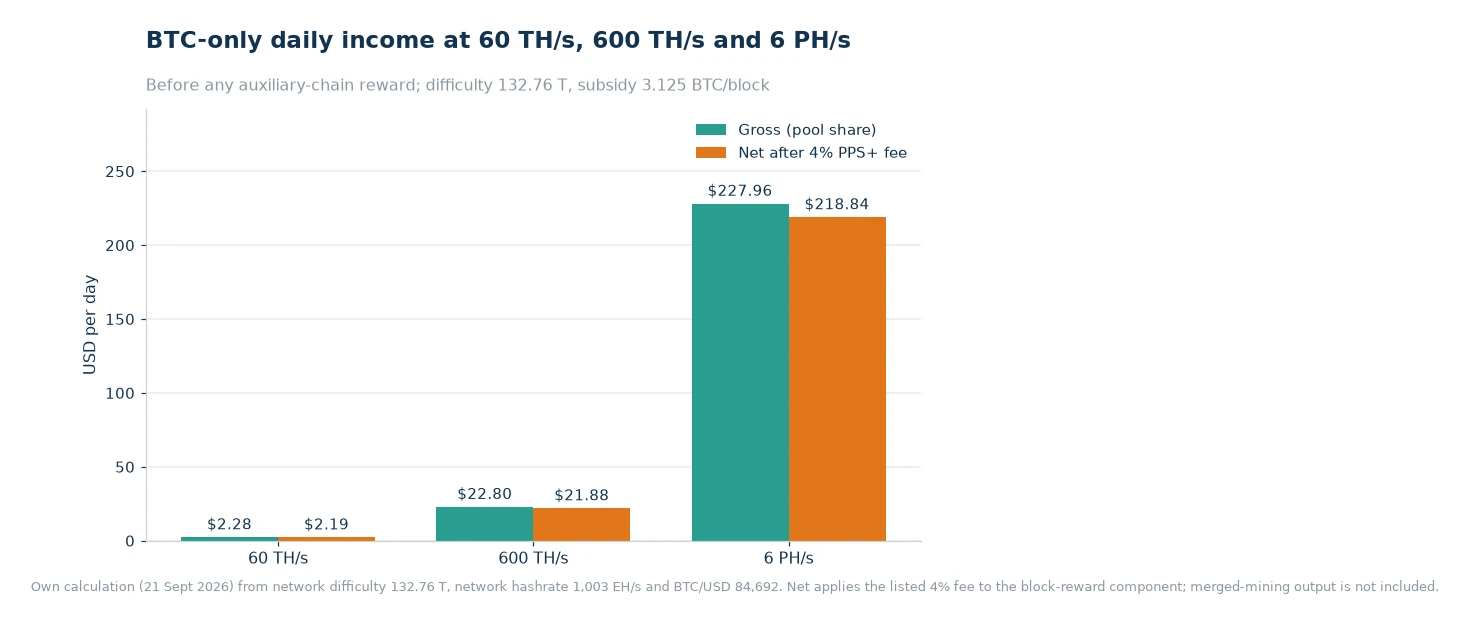
The distinction matters most at the small end. A 60 TH/s machine keeps only $0.46 a day on BTC alone, so any second stream that adds even a few percent of gross is proportionally significant to that machine's viability. On a 6 PH/s farm sitting on $46.04 a day of BTC margin, the same proportional addition is worth more in absolute terms but changes no decisions. What ViaBTC Crypto Mining offers here is breadth: the same account and the same rig can run several chains, so configuration rather than procurement decides which streams are active.[3]
Practical next steps
- Confirm your pool supports the pair you want. Merged mining only exists where the operator runs both chains; a coin list that includes LTC/DOGE, BTC, BCH, KAS and others is the prerequisite.
- Enable it per worker, not per account-wide guess. Run a single machine with the auxiliary chain active for a full difficulty round and compare realised payouts with the same period before the change.
- Check the payout destination before the first distribution. Auxiliary coins need somewhere to land, and a multi-currency wallet that supports the asset and offers auto conversion avoids a manual transfer step.
- Re-run the calculator with merged output included. Many third-party sheets omit the auxiliary stream, which makes a marginal rig look worse than it is — or a large rig look better than it is.
- Watch per-worker hashrate after the change. A mining pool dashboard that reports both streams tells you whether a configuration change cost you BTC shares.
Frequently asked questions
Can I mine more than one coin at the same time?
Yes. Merged mining lets a machine secure a parent chain and an auxiliary chain together, and multi-coin pools support switching between chains without moving hardware.
Do mining pools cost anything to join?
Joining is free; the pool earns from its fee on settled payouts, which appears as a percentage of the block-reward and transaction-fee components.
Does merged mining increase power consumption?
No, the machine performs the same hashes it was already performing. The indirect cost is exposure to the auxiliary asset's price and the pool fee that applies to that stream.
Turn it on for one machine first
Treat the first merged-mining machine as an experiment with a measurement attached: baseline its BTC-only payout for a week, enable the auxiliary chain, then compare realised totals per terahash rather than per coin. Keep it if the combined payout per unit of power rises; revert if it does not.
Then apply the same rule at fleet scale, and revisit it whenever an auxiliary chain's difficulty or price changes materially. The configuration is reversible in minutes, which is the whole argument for testing it on real hardware instead of modelling it.
Data and sources: ViaBTC mining guides[1], ViaBTC fee schedule[2] and ViaBTC profit calculator[3]; network difficulty and hashrate from public chain data, all read on 21 September 2026. BTC figures are own calculations from difficulty 132.76 T, network hashrate 1,003 EH/s and BTC/USD 84,692; auxiliary-chain rewards are not included in any number here.