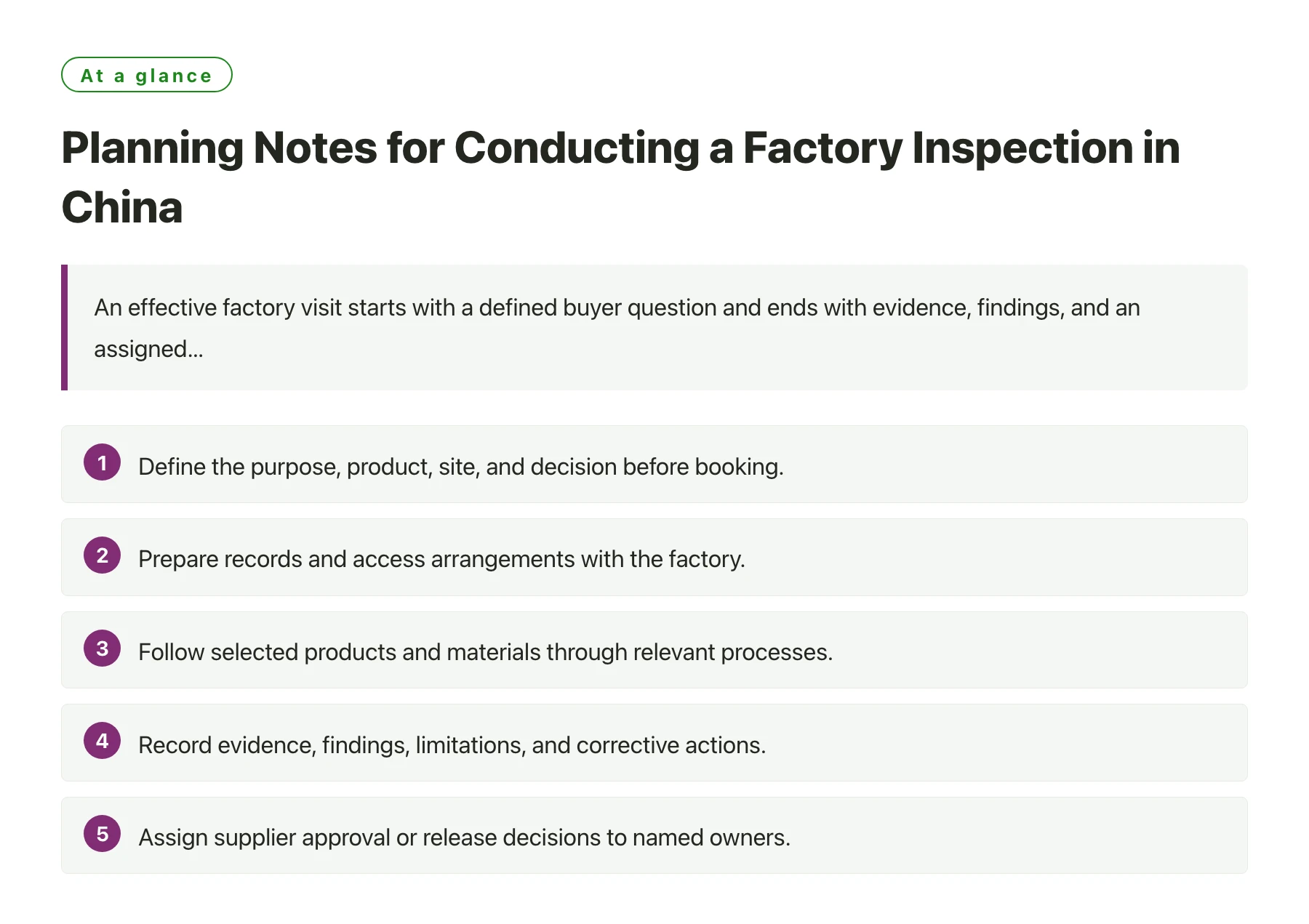
An effective factory visit starts with a defined buyer question and ends with evidence, findings, and an assigned decision. Confirm the site and participants, prepare controlled documents, choose process observations, and record limits. A factory tour alone does not verify product conformity or approve an order.
Key takeaways
- Define the purpose, product, site, and decision before booking.
- Prepare records and access arrangements with the factory.
- Follow selected products and materials through relevant processes.
- Record evidence, findings, limitations, and corrective actions.
- Assign supplier approval or release decisions to named owners.
A visit plan links site observations to the product, order, and buyer decision.
1. Turn the buyer concern into an inspection question
Write the question the visit should answer: does the named site make the product, can it meet the planned volume, are process records maintained, or is an order ready for inspection? Identify the product, model, order, revision, production stage, and decision date.
Keep supplier qualification, order monitoring, product inspection, and compliance review as separate objectives unless a combined scope is deliberately planned. The inspection plan should say which decision is supported and what evidence would change it.
2. Confirm location, participants, and authority
Verify the factory address and legal or commercial relationship with the supplier. List subcontractors and processes they perform. Ask the supplier to identify a site representative, production contact, quality contact, and person authorized to provide records.
Confirm visitor identity, interpretation, safety briefing, personal protective equipment, photography rules, confidentiality, and access permissions. Set a backup date or remote alternative if production is not running.
Share arrival time, expected duration, visitor count, and contact details. Ask the site to keep relevant work orders and records accessible without preparing unrelated documents. Confirm whether the visit can include a warehouse or subcontractor area and what alternative evidence is acceptable if access is denied.
3. Prepare the document pack
Send current specification, drawings, process flow, capacity request, sample criteria, order quantity, and any buyer checklist in advance. Ask for relevant procedures, training, calibration, material traceability, inspection logs, and corrective-action examples.
ISO 9001:2026 sets quality management system requirements; a certificate can be one input to process review, but it does not by itself show that the site, product, or order meets buyer requirements. Sample actual records and verify their connection to the named factory. [1]
4. Plan a route through the operation
Map a simple route from receiving to storage, preparation, key processing, in-process control, final inspection, packing, and dispatch. Select stages that matter for the product’s critical characteristics. Prepare questions tied to each stage instead of touring equipment without a decision purpose.
If a process is outsourced, plan how to assess the subcontractor or request alternate evidence. Record the process, site, equipment, operator role, control point, records, and any differences from the approved process flow.
5. Check traceability in both directions
Select a finished unit and trace it back to work order, materials, incoming checks, process records, and operator or equipment data where relevant. Select a material lot and trace it forward to the products or orders that used it. Compare physical labels with records.
Check how mixed, rejected, reworked, or returned goods are identified and segregated. Ask how obsolete drawings and instructions are removed from work areas. Use a small, clearly logged sample and avoid suggesting that every record was reviewed.
6. Observe what is happening during normal work
When possible, observe a real run of the relevant process. Ask workers to explain setup, inspection, defect reporting, and change control. Compare answers with instructions and sampled results. Note whether production conditions match the supplier’s stated capacity and process.
If the line is idle, a process is unavailable, or the supplier restricts access, record that limitation and the evidence used instead. Do not infer performance from a staged demonstration or an unused machine.
7. Document evidence and findings
For each finding, capture the requirement or question, evidence, location, date, record sample, and product or process affected. Separate objective observations from conclusions. Use photos only where permitted and link each image to the observation.
Classify gaps by severity and define containment, corrective action, owner, deadline, and verification. Escalate critical conditions to the buyer promptly. Leave missing technical criteria to the designated engineering or quality owner.
8. Coordinate follow-up and decision
Issue a report within the agreed timeframe, including scope, participants, methods, records, areas observed, findings, limitations, and conclusion. Ask the supplier to respond to factual errors and corrective-action requests in writing. Preserve the original observations.
Name who determines supplier approval or order release. If new evidence changes the assessment, record the decision and its basis. Revisit the site or schedule a product inspection if the visit could not establish a critical requirement.
9. Request the right support
A local coordinator may assist with scheduling, translation, transport, record requests, and report follow-up. Define the role, confidentiality, scope, fees, and limits. Technical conclusions should remain with qualified reviewers and the buyer’s authorized team.
Buyers evaluating JS Sourcing factory inspections in China can request a written agenda, methods, deliverables, exclusions, and follow-up terms before arranging a visit.
Sources
Frequently asked questions
How far ahead should a factory visit be planned?
Allow time for site confirmation, safety and access arrangements, records, translation, and production availability; schedule around the process to be observed.
What documents should a buyer send before the visit?
Provide current product requirements, order and revision details, scope questions, criteria, and a focused list of records or evidence requested.
Does a factory visit approve the supplier automatically?
No. The visit supports a defined decision; unresolved findings and other qualification or product requirements may remain.
What should the final report include?
Record scope, site, participants, method, evidence, observations, findings, limitations, corrective actions, and decision owner.