Osmanthus, jasmine sambac, gardenia and tea are the materials most often named when a brief asks for a Chinese or oriental direction, and each of them behaves differently in a formula. Two are available as genuine naturals at considerable cost, one is usually better served by reconstruction, and all of them are easy to use badly. The difference between a convincing Chinese palette and a cliché is not the material list; it is how the materials are balanced against each other.
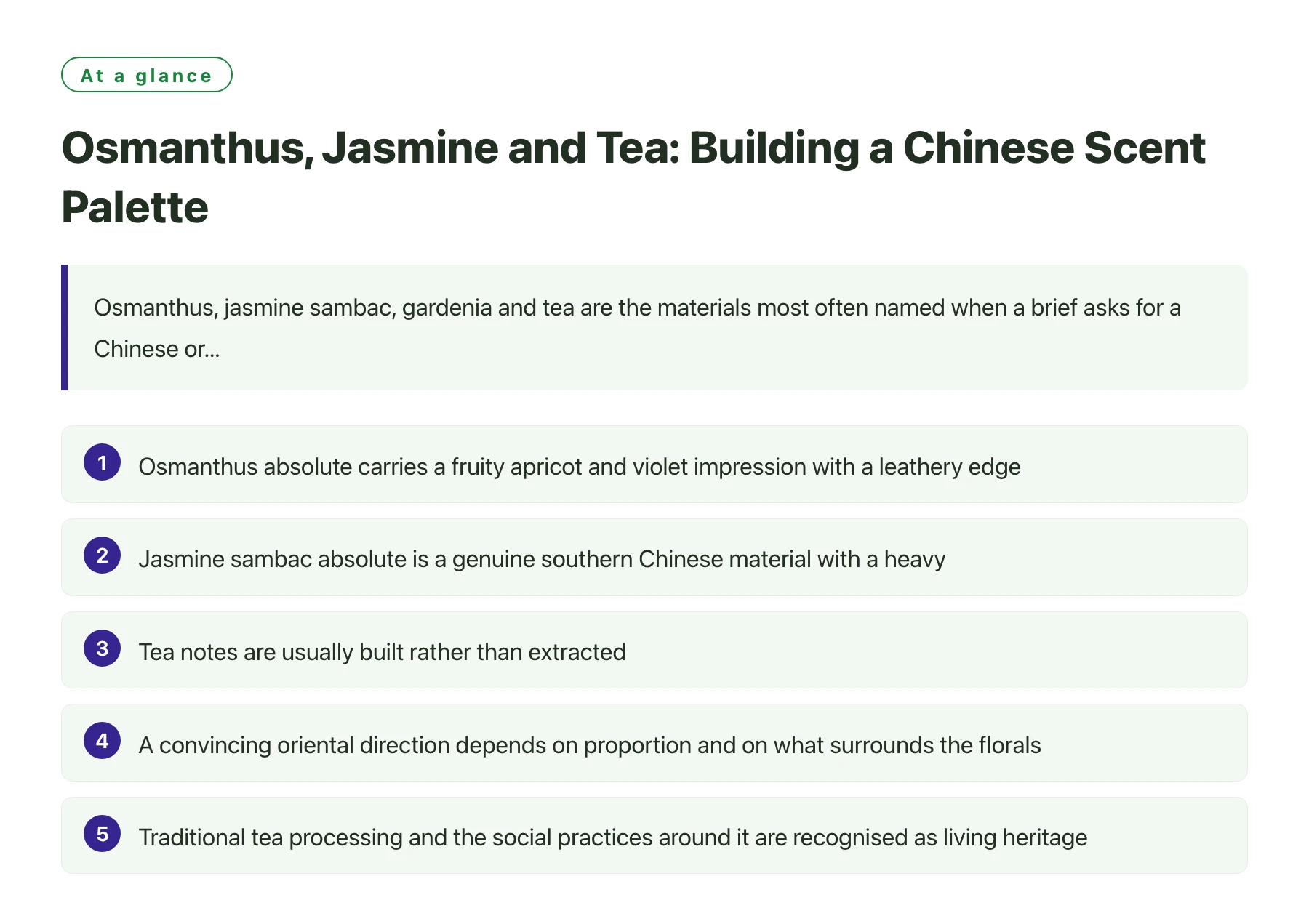
Key takeawaysOsmanthus absolute carries a fruity apricot and violet impression with a leathery edge, and its cost reflects a low yield from a short harvest window. · Jasmine sambac absolute is a genuine southern Chinese material with a heavy, slightly animalic floral character that behaves very differently from jasmine reconstructions. · Tea notes are usually built rather than extracted, because the material gives a subtle and fragile impression that is hard to carry through a full formula. · A convincing oriental direction depends on proportion and on what surrounds the florals, not on how many recognisable Chinese materials are listed. · Traditional tea processing and the social practices around it are recognised as living heritage, which is one reason a tea note reads as cultural rather than merely green [3].
Ask a product team for a Chinese fragrance and the same four or five materials come back: osmanthus, jasmine, tea, sometimes gardenia, occasionally plum blossom. The list is not wrong. It is just incomplete as a brief, because it names ingredients without describing a composition.
Materials behave in company. Osmanthus next to a clean white musk reads as apricot and suede; the same osmanthus next to a dense amber reads as jam. The surrounding formula decides which face of the material a customer meets.
This article looks at what these materials actually contribute, where sourcing them is straightforward and where it is not, and how to write a brief that produces something specific rather than decorative.
What each material actually contributes
The most useful way to think about these materials is in terms of function rather than origin. Each one occupies a position in the formula — a bright opening, a heavy heart, a soft base — and the position matters more than the passport.
Two of them are unusually versatile and two are unusually difficult, which is worth knowing before the brief is written.
Osmanthus: apricot, violet and a leathery edge
Osmanthus presents a fruity floral impression that sits somewhere between apricot, violet and a soft leather. Material reference databases used by perfumers describe it in exactly those terms, which is a useful reminder that the material is not a simple floral [1].
The characteristic apricot-and-violet impression comes largely from ionone-type molecules, the same family that gives violets and raspberry their recognisable character [2]. That shared chemistry is why osmanthus blends so easily into fruity and violet accords and so awkwardly into very dry compositions.
Manufacturers that work with this palette continuously, including the Guangzhou-based house Xuelei, tend to treat osmanthus, jasmine and tea as a working vocabulary rather than as a seasonal theme, which is the difference between a direction that reads as considered and one that reads as decorative.
Jasmine sambac and gardenia: heavy, generous florals
Jasmine sambac is a genuine southern Chinese material, and its absolute is heavy, slightly animalic and extremely persistent. It anchors a heart rather than decorating it, and a small amount goes a long way.
Gardenia is harder. The flower's creamy, slightly green character is difficult to capture faithfully in an extract, so most commercial gardenia notes are reconstructions built from other materials. That is not a compromise; it is how the material is normally worked with.
Sourcing realities for a Chinese palette
| Material | Olfactive role | Sourcing reality | Blends well with |
|---|---|---|---|
| Osmanthus absolute | Fruity floral heart with a suede edge | Low yield and a short harvest window, so cost is high and supply varies by season | Violet, apricot, soft leather, white musk |
| Jasmine sambac absolute | Heavy floral heart | Available as a genuine natural; used at low dosage because of its strength | Green tea, orange blossom, sandalwood |
| Gardenia note | Creamy green floral | Usually reconstructed rather than extracted, because the flower does not yield faithfully | Tuberose, green leaves, coconut facets |
| Tea note | Fresh, slightly bitter, translucent | Normally built from other materials; extracts tend to be fragile and faint | Jasmine, bergamot, light woods, rice notes |
| Plum blossom and magnolia | Light, airy floral top | Typically reconstructions aimed at an impression rather than a single flower | Aldehydes, peony, clean musk |
The pattern in the third column is worth noticing. Of the materials most associated with Chinese fragrance, only a few are practically available as true naturals at commercial scale. A brief that demands natural extracts for all of them will be expensive, inconsistent between seasons, and often less accurate to the flower than a well-built reconstruction.
How to brief the direction without falling into clichés
A brief that lists materials produces a formula that smells like the list. A brief that describes a moment produces something a customer can remember.
The difference is usually a matter of one paragraph in the brief.
Describe the scene rather than the ingredients
Instead of asking for osmanthus and tea, describe an autumn evening, cool air, a cup going cold on a stone table, and the sweetness of fruit somewhere behind it. The perfumer will still reach for osmanthus and tea, but will balance them differently.
This approach also gives the development team a way to evaluate drafts. Two samples can be compared against the description rather than against a preference for one material over another.
Control the sweetness and the density
The most common failure in an oriental direction is over-density. Adding more florals and more resins makes the composition heavy rather than rich, and the individual materials disappear into a single sweet mass.
The fix is contrast. A translucent tea accord beside a heavier floral heart restores the sense of space, which is what makes the florals legible again. For a closer look at how these materials are sourced and worked, see the raw materials behind Chinese scent traditions.
A workable development sequence for a Chinese direction
- Set one anchor material, not fourChoose the material that carries the idea and let the others support it, so the composition has a subject rather than a theme.
- Build the tea or green facet firstTranslucent top and heart materials are the hardest to add later without unbalancing the formula, so establish them before the base.
- Sample at two sweetness levelsAsk for the same direction with less and more sweetness; the comparison shows quickly where the market's expectation actually sits.
- Check the natural against the reconstructionSmell the genuine absolute beside the reconstructed version, so the choice is made on character and cost rather than on principle.
- Test the dry-down on skin, not paperHeavy florals and resins behave very differently on skin, and the base is where an oriental direction is either convincing or tiring.
The most useful discipline in this part of fragrance work is to stop treating origin as a quality argument. A reconstruction can be closer to the flower in the air than an expensive absolute, and a genuine extract can be the wrong choice if its yield makes the product unaffordable or its season makes supply unpredictable. What matters is whether the material does its job in the composition and whether the supply is stable enough to repeat next year. Cultural story and material cost are two separate conversations, and mixing them is how a promising direction becomes a product that cannot be produced twice.
Sources
- The Good Scents Company —— A reference database of aroma materials with odour descriptions, CAS numbers and typical usage information.
- Chemistry World (Royal Society of Chemistry) —— The Royal Society of Chemistry's magazine, covering chemistry research and explanations of everyday materials including aroma compounds.
- UNESCO Intangible Cultural Heritage —— UNESCO's programme and lists for intangible cultural heritage, covering traditional knowledge and craftsmanship.
Frequently asked questions
What does osmanthus smell like in perfume?
It reads as a fruity floral with apricot and violet facets and a soft leathery undertone, which is why it works in fruity accords as well as in suede and tea compositions. Its cost is relatively high because the yield from the flower is low and the harvest window is short.
Is there a real tea essential oil for fragrance?
Tea extracts exist but are faint and fragile, and they rarely carry through a full formula. Most commercial tea notes are reconstructions built to give a fresh, slightly bitter, translucent impression. That is standard practice rather than a shortcut, and it usually performs better.
Why is jasmine sambac important in Chinese fragrance?
It is a genuine southern Chinese material with a heavy, generous floral character that anchors a heart rather than decorating it. Used at low dosage it adds depth and persistence, and it blends naturally with green tea, citrus and light woods.
How do I avoid a clichéd oriental fragrance?
Replace the material list with a scene, set one anchor material instead of four, and introduce contrast rather than more sweetness. Density is the usual failure: past a certain point, additional florals and resins do not make a composition richer, they make it less legible.
Should I insist on natural materials for an oriental brief?
Only where the natural genuinely performs better. Several of the materials associated with Chinese fragrance are difficult or uneconomical to extract, and reconstructions often match the flower more faithfully in the air. Judge each material on character, stability of supply and cost rather than on origin.