Breaks, Not Bans: Sustainable Adult AI Chat Use
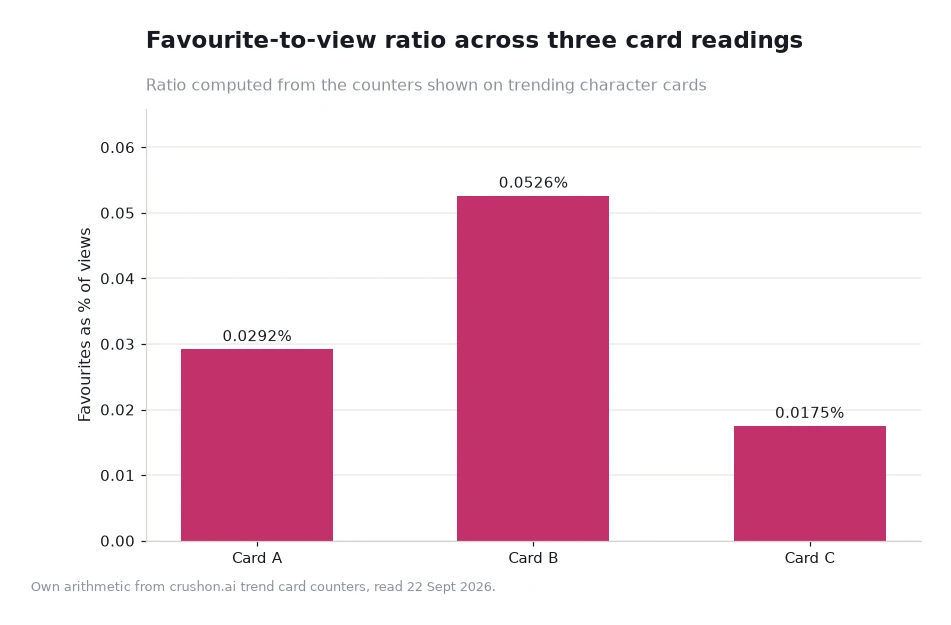
A ban is a decision made once and regretted every evening; a break is a decision made once and completed. The difference is not willpower but design: a break has a date, a reason and a return plan, which is why it survives contact with a quiet Tuesday. On the numbers, the point is not how strictly you abstain but where the habit settles — readings of 0.0292% and 0.0526% favourites per view sit comfortably above one at 0.0175%, and the same spread applies to how well a routine holds up over months.

Key takeaways
- Give a break an end date. Open-ended abstinence converts a habit into a negotiation you have with yourself nightly.
- Make the break structural rather than moral: change the cue, such as notifications or the app's position on the home screen.
- Return deliberately. Re-read the last exchange before adding to it, and the thread resumes rather than restarting.
- Arithmetic for scale: seven sessions a week at 12 minutes is 84 minutes a week, roughly six hours a month.
Why bans backfire
A ban fails for the same reason diets do: it removes a routine without replacing the moment that routine occupied. The slot stays empty, the cue still fires, and the first lapse is read as failure rather than as data, which usually ends in a heavier return than the habit that prompted the ban.
There is also a structural argument for the softer option. Adult chat is a low-cost habit by design: the app is on the phone, the sessions are short, and nothing about the medium imposes a natural stopping point. Habits without a stopping point need one built in, and a scheduled break supplies it without the drama of prohibition.
A third reason is that strictness distorts the measurement. After a ban, any use feels like a relapse, so people stop tracking and start hiding. That eliminates the only feedback loop that would have kept the habit in proportion, which is a worse outcome than the habit itself.
Designing a break that holds
Set a start, an end and a reason. A 48-hour break is short enough to keep and long enough to break a cue: skip one evening, then the next, and you learn whether the habit had an appetite behind it or just a pattern. If the pattern is the issue, two days will feel trivial; if the appetite is the issue, you will know by hour thirty.
Change something structural while you are away. Notifications off is the single most effective change, because it moves the app from prompting you to being something you open. Moving the icon off the home screen is the second, for the same reason. Neither requires discipline; both remove a trigger.
Plan the return before you start. Decide which thread you will reopen, what you will do in the first ten minutes, and how many sessions the following week gets. A return with a plan is a resumption; a return without one is a drift back to the previous volume, usually within four days.
| Break | What it tests | How to return |
|---|---|---|
| One evening | Whether the habit is cue-driven or appetite-driven | Reopen the same thread the next day and note whether context survived |
| Two days | Whether the volume was deliberate or default | Return with a fixed session count for the week |
| One week | Whether the slot needs filling with something else | Choose one listing, re-read the last exchange, then continue |
| Return check | Whether quality dropped without the rhythm | Compare your own messages before and after for register drift |
Worked example
The first calculation is on published counters and shows why attention decays rather than breaks. A card keeping 0.0292% of its views as favourites holds 2.92 per 10,000; one at 0.0526% holds 5.26; one at 0.0175% holds 1.75. The strongest is about three times the weakest, a spread that looks like a difference in quality but often reflects whether the register was held consistently over time.
The second is the time budget, and it is illustrative rather than platform data. Seven sessions a week at 12 minutes each is 84 minutes a week. Multiply by four weeks: 336 minutes, or about 5.6 hours a month. A two-day break removes roughly 24 of those minutes; a one-week break removes about 84.
The useful comparison is not the saving but the proportion. A week away costs about a sixth of the monthly total, which is small enough to be sustainable, and it is the reason a scheduled break is easier to keep than a ban: the cost is bounded and known in advance.
Returning well
The return is where most of the value sits, because a break that ends in a cold restart throws away the continuity the platform is built to provide. Re-read the last exchange before writing anything. That one habit restores context in under a minute and makes the difference between resuming a conversation and beginning a new one with the same name.
A second habit is to return with a smaller budget than you left with. Eight sessions a week is a reasonable place to resume after seven; reverting to twelve immediately means the break had no effect on the pattern. And if you want to check how other people's routines look, the AI chat blog and the character search view are both passive ways to browse without starting a session.
One last consideration applies to the reason you are breaking at all. If the aim is to free an evening, an AI chat break will do it, because the sessions are the thing occupying the slot. If the aim is to feel differently about something else, the platform is not where the answer lives — and Crushon's Porn Chat AI overview page at the ai porn chat address is at least an honest account of what the product is and is not, since its FAQ states that limitations apply under the content and community guidelines.
Frequently asked questions
How long should a break be?
Start with 48 hours. It is long enough to interrupt the cue and short enough to complete, which is what makes it useful information rather than punishment.
Should I delete the app?
Not as a first step. Turning notifications off and moving the icon changes the trigger while leaving the choice intact, which is easier to sustain.
How do I know the break worked?
If the week after it runs at a lower session count without effort, the habit had a default behind it. If nothing changes, the volume was deliberate.
Schedule the pause, then keep it
Choose the length, turn off the prompts, and decide now what the first session back looks like. The break only has to be long enough to break a pattern. Two days away, one change to the cue and a written plan for returning is the entire method, and none of it depends on willpower, which is why it tends to hold.
Write the session count for the following week somewhere you will see it. Six weeks of that habit produces a routine you chose instead of one you drifted into, and it is also long enough to show whether a break was a pause or a correction. Adults 18 and over only.
Data and sources: trend card counters and the platform FAQ, read on 22 Sept 2026[1]. Ratio figures are arithmetic on those counters; the seven-session week, the 84-minute total and the monthly hours are illustrative assumptions, not platform data. Written for readers aged 18+.